
How to Fill Out a Job Application (Step-by-Step Guide 2026)
Everything you need to know to fill out job applications correctly, stand out from other candidates, and avoid the mistakes that get applications rejected.
Job applications are annoying. They take forever to fill out, they ask for information you already put in your resume, and half the time they’re badly designed forms that crash when you’re 90% done.
But here’s the reality: if you want the job, you have to fill out the application. And not just fill it out—you need to do it right.
Most people rush through job applications, make preventable mistakes, or skip important sections thinking they don’t matter. Then they wonder why they never hear back.
This guide will walk you through exactly how to fill out a job application—whether it’s online or on paper, entry-level or executive—so you can submit applications that actually get noticed.
Let’s get into it.
Before You Fill Out a Job Application
Don’t just click “Apply Now” and start typing. A little prep work will save you time and help you avoid mistakes.
What You’ll Need
Gather these before you start filling out job applications:
- Your resume (updated and ready to upload)
- Cover letter (if required, tailored to this job)
- Employment history with exact dates (month/year started and ended)
- Education details (schools attended, degrees, graduation dates)
- References (names, titles, contact info—get permission first)
- Previous addresses (some applications ask for your last 5-10 years of addresses)
- Salary expectations (research the role’s typical pay range first)
Pro tip: Create a master document with all this information. When you need to fill out a job application, you can copy and paste instead of hunting for dates and addresses.
Read the Job Description Carefully
Before you start filling out the job application, read the entire job posting. Look for:
- Required qualifications (deal-breakers)
- Preferred qualifications (nice-to-haves)
- Key skills and keywords
- Specific instructions (some applications have special requirements)
You’ll use this information when you fill out the job application to match your experience to what they’re looking for.
How to Fill Out a Job Application: Section by Section
Most job applications follow a similar structure. Here’s how to fill out each section correctly.
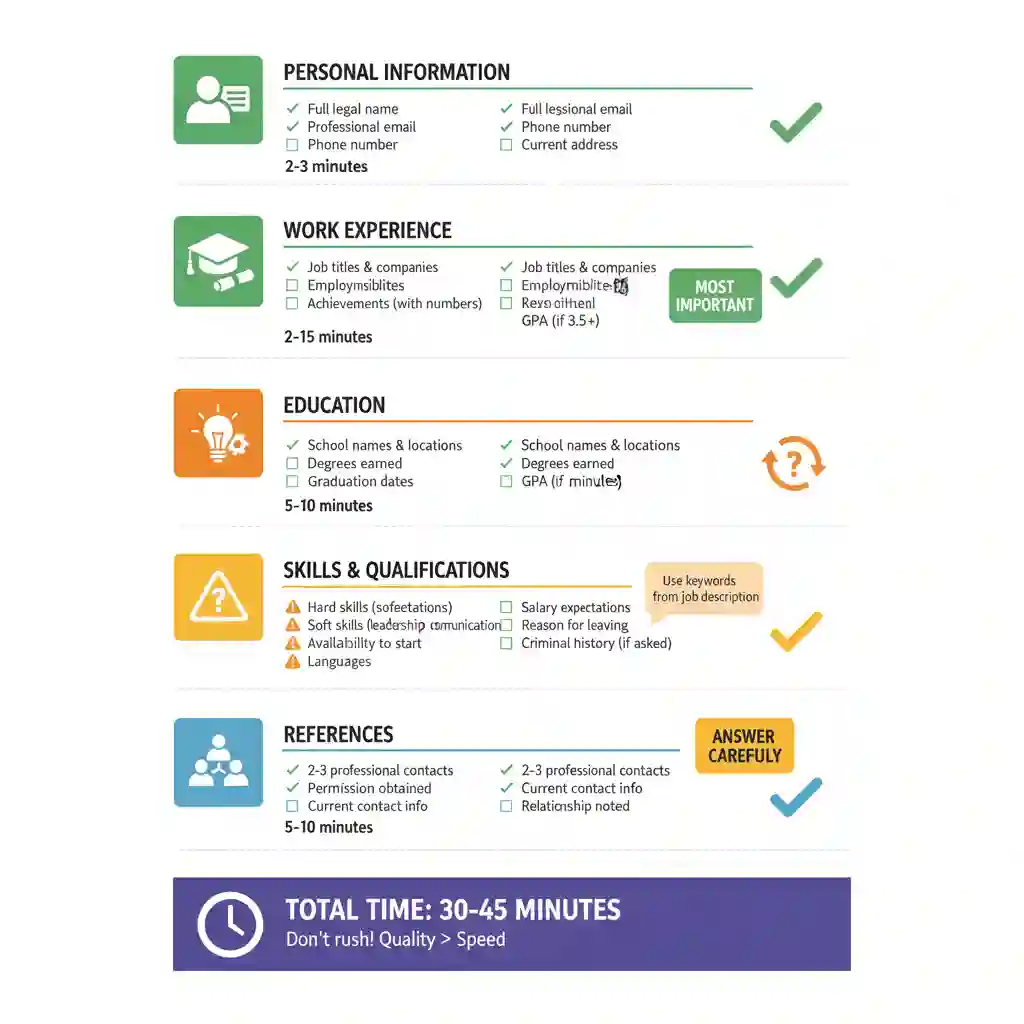
Section 1: Personal Information
This seems straightforward, but mistakes here can get your application rejected before anyone even reads it.
Name
- Use your legal name (or the name on your official documents)
- Match the name on your resume exactly
- If you go by a different name, you can include it: “Robert (Bob) Smith”
Contact Information
- Email: Use a professional email address (firstname.lastname@email.com). No “partygirl87@hotmail.com”
- Phone: Include area code. Make sure your voicemail is set up and professional
- Address: Full mailing address. Some applications only ask for city/state—that’s fine
- LinkedIn: Include if the application asks. Make sure your profile is updated
Double-check for typos. If they can’t reach you because you typed your email wrong, you won’t get the job.
Are You Legally Eligible to Work?
This asks if you’re authorized to work in the country where the job is located.
- If yes: Select yes
- If no: Select no—but know this might disqualify you unless the employer sponsors visas
- Work visa holders: Answer yes if you currently have work authorization, even if it requires sponsorship to renew
Section 2: Work Experience
This is the most important section when you fill out a job application. Take your time here.
For Each Job, Include:
- Job Title
Use your official title. If your title was weird (“Happiness Engineer”), you can clarify: “Happiness Engineer (Customer Support Specialist)”
- Company Name
Full, official company name. Include location (city, state) if the application asks.
- Dates of Employment
Use Month/Year format (e.g., “June 2020 – Present” or “03/2020 – Present”). Be accurate—employers verify this.
- Supervisor Name and Contact
Some applications ask for this. If you don’t want them contacting your current boss, check “May we contact this employer?” and select “No” or “After offer.”
- Responsibilities and Achievements
This is where you stand out. Don’t just copy your resume. Highlight:
- Key responsibilities relevant to THIS job
- Quantifiable achievements (“increased sales by 25%”)
- Skills that match the job description
How many jobs to list?
- Most recent 10 years minimum
- Focus on relevant positions
- If you have 20+ years of experience, you can summarize earlier roles: “Additional experience: Various sales positions, 1995-2005”
Employment Gaps
If you have gaps in employment, don’t lie or leave them blank. Address them briefly:
- “Full-time student” (if you were in school)
- “Family care responsibilities”
- “Freelance/Consulting work”
- “Career break” (no need to over-explain)
Gaps happen. Most employers understand as long as you’re honest.
Also check Indeed.com’s guide on how to fill out a job application.
Section 3: Education
What to Include:
- School name (full official name)
- Location (city, state)
- Degree type (Bachelor’s, Master’s, Associate, etc.)
- Major/Field of study
- Graduation date (month/year or just year)
- GPA (if requested or if it’s impressive—3.5+)
Common Questions:
“I didn’t graduate—should I still list the school?”
Yes. List the school, dates attended, and field of study. Where it asks for graduation date, write “Attended” or leave blank. Don’t lie.
“I only have a high school diploma. Is that okay?”
Absolutely. List your high school. If you have relevant certifications or training, add those too.
“Should I include old education?”
List your highest level of education. If you have a Bachelor’s, you don’t need to list high school unless the application requires it.
You may need Chat GPT or other premium tools to assist in writing your application. You can buy these tools and VPNs at very low price from us.
Section 4: Skills and Qualifications
When you fill out a job application, this section is your chance to match keywords from the job description.
What to Include:
- Hard skills: Software, tools, technical abilities (Excel, Python, Photoshop, etc.)
- Soft skills: Communication, leadership, problem-solving (but be specific)
- Certifications: Professional licenses, industry certifications
- Languages: Any additional languages (specify proficiency level)
Pro tip: Pull keywords directly from the job description. If they want “project management,” use that exact phrase, not “managed projects.”
Don’t lie. If you list “proficient in Spanish” and they test you in the interview, you’ll look terrible.
Section 5: The Tricky Questions
These questions trip people up when they fill out job applications. Here’s how to handle them.
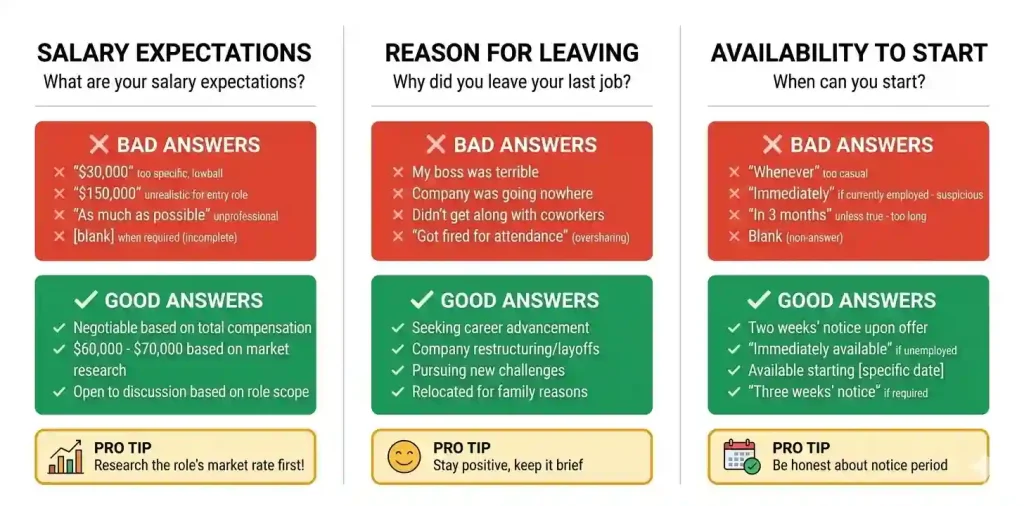
“Desired Salary” or “Salary Expectations”
This is a negotiation trap. Here’s how to handle it:
- If it’s optional: Leave it blank or write “Negotiable”
- If it’s required: Research the market rate for this role in your area. Give a range: “$60,000 – $70,000”
- Never lowball yourself. It sets a bad precedent
“Reason for Leaving” Previous Jobs
Keep it brief, professional, and positive:
- “Career advancement opportunity”
- “Seeking new challenges”
- “Company restructuring/layoffs”
- “Relocated for family reasons”
- “Contract ended” (if it was a temp position)
Don’t: Trash talk your old boss, complain about coworkers, or go into detail about conflicts.
“When Are You Available to Start?”
- If unemployed: “Immediately” or “Two weeks’ notice upon offer”
- If currently employed: “Two weeks’ notice” (standard) or “Three weeks’ notice” (if your current role requires it)
- If you need time: Be honest: “Available starting [specific date]”
“Have You Ever Been Convicted of a Crime?”
Answer honestly. Many states have “ban the box” laws that limit when employers can ask this.
- If yes: Check yes, but you’ll likely have a chance to explain. Keep it brief and focus on rehabilitation
- If no: Check no
Don’t lie. Background checks will reveal this, and lying on an application can be grounds for immediate termination even after you’re hired.
Section 6: References
Most applications ask for 2-3 professional references when you fill out a job application.
Who to List:
- Former managers or supervisors (best option)
- Colleagues who can speak to your work
- Professors (if you’re a recent grad)
- Clients (if relevant and professional)
Don’t list:
- Family members
- Friends (unless they were also professional colleagues)
- Your current boss (if you don’t want them knowing you’re job searching)
What to Include:
- Full name
- Job title
- Company
- Phone number
- Email address
- Your relationship (“Former supervisor,” “Colleague,” etc.)
IMPORTANT: Ask permission before listing someone as a reference. Give them a heads up about the job and send them the job description so they can tailor their recommendation.
Online vs Paper Job Applications: What’s Different
Online Applications
- Save as you go: Many systems time out. Save progress frequently
- Beware auto-fill: Review everything—auto-fill makes mistakes
- File formats: Upload resume as PDF unless specified otherwise (Word docs can get corrupted)
- File names: Name files professionally: “FirstName_LastName_Resume.pdf”
- ATS systems: Use standard fonts, avoid graphics, include keywords from job description
Paper Applications
- Print it first: Print a copy to practice before filling out the real one
- Write neatly: Use black or blue ink. No crossed-out mistakes
- Bring a copy of your resume: Attach it to the application
- Read instructions carefully: Some ask for block letters, some ask for cursive signatures
Common Mistakes When You Fill Out a Job Application
Mistake 1: Typos and Grammar Errors
One typo can tank your application. Proofread everything. Use spell-check. Have someone else review it. Typos suggest carelessness.
Mistake 2: Leaving Sections Blank
If something doesn’t apply, write “N/A” instead of leaving it blank. Blank spaces look like you forgot or didn’t care.
Mistake 3: Inconsistent Information
Make sure dates, job titles, and details match your resume exactly. Inconsistencies raise red flags.
Mistake 4: Being Generic
Tailor your application to the specific job. Use their keywords. Show you actually read the job description.
Mistake 5: Lying or Exaggerating
Don’t lie about degrees, job titles, dates, or skills. Background checks and reference calls will expose lies, and you’ll be fired or blacklisted.
Before You Submit: Final Checklist
Before you hit “Submit,” go through this checklist:
- Proofread everything (twice)
- Verify all contact information is correct
- Double-check dates and job titles match your resume
- Confirm you’ve answered all required questions
- Review uploaded documents (right files, correct format, readable)
- Make sure references gave permission and have current contact info
- Save a copy for your records (screenshot or PDF)
After You Fill Out a Job Application: What’s Next
Keep Track
Log the application in a spreadsheet:
- Company name
- Job title
- Date applied
- Follow-up date
- Status (applied, interviewed, rejected, offer)
Follow Up
- When: Wait 1-2 weeks after applying
- How: Email is usually best (“I wanted to follow up on my application for [Job Title]…”)
- Don’t: Call multiple times, show up in person (unless it’s retail/service), or send multiple emails
Be Patient
The hiring process takes time. Many companies take 2-4 weeks to review applications. Some take longer. Don’t assume rejection just because you haven’t heard back yet.
The Bottom Line on How to Fill Out a Job Application
Filling out job applications isn’t glamorous, but doing it right dramatically increases your chances of getting called for an interview.
The key points:
- Prepare before you start (gather all info first)
- Fill out every section completely and accurately
- Tailor your application to the specific job
- Proofread everything before submitting
- Never lie or leave sections blank
- Track your applications and follow up appropriately
Yes, applications take time. But the jobs go to people who fill them out completely and professionally. Be one of those people.
Now go fill out that job application and land the interview.
Ready for the Next Step?
Check out our guides on writing resumes, preparing for interviews, and following up after applications.