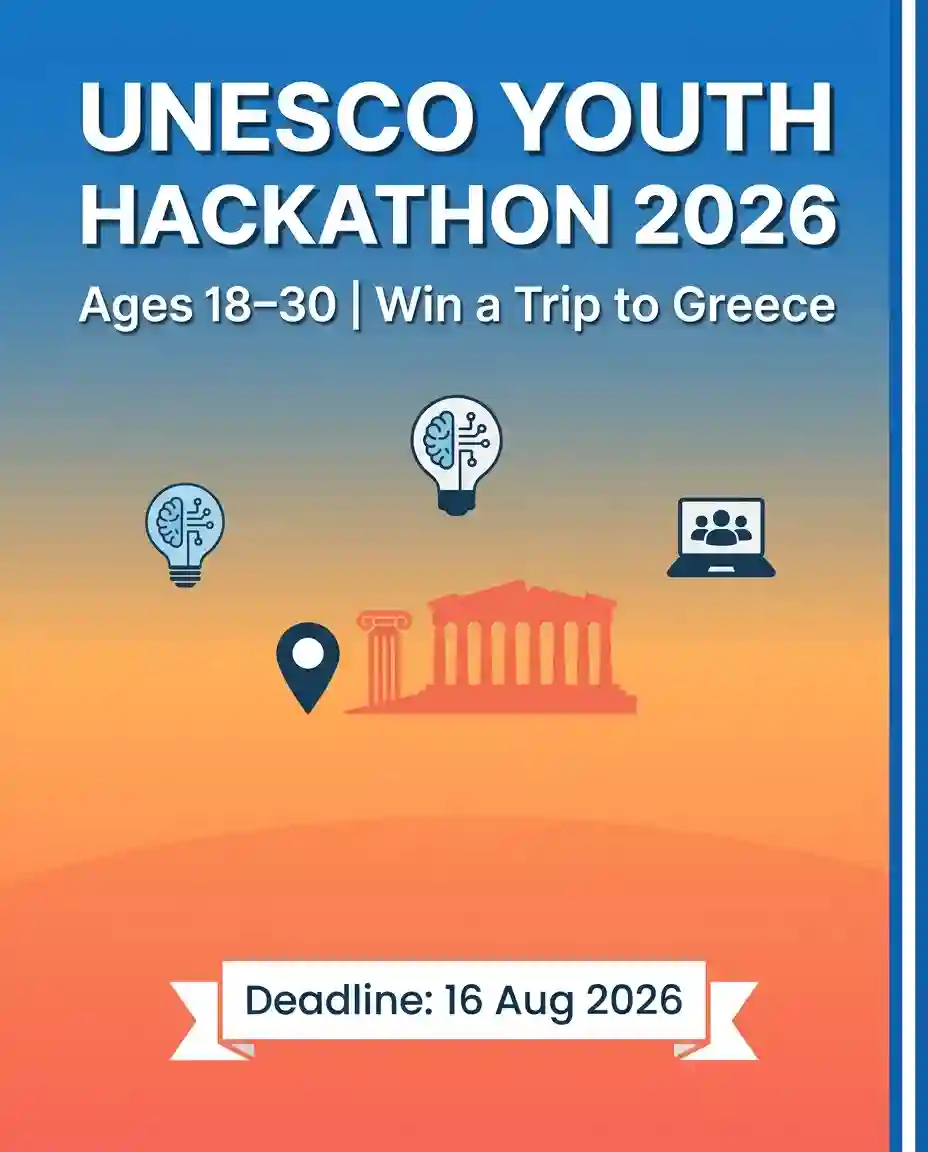
UNESCO Youth Hackathon 2026: Win a Trip to Greece
UNESCO has opened submissions for the Youth Hackathon 2026, a global competition for young people aged 18 to 30 to design solutions around Media and Information Literacy (MIL). This year’s theme is “Play Your Part: Youth Designing the Future of Media and Information Literacy.” Teams of 2 to 6 members can submit a project proposal and pitch video, and four winning teams will be invited to Thessaloniki, Greece, in November 2026. The submission deadline is 23:59 Paris time on 16 August 2026 — only a couple of days away, so applicants should not delay.
Quick Summary
| Detail | Information |
|---|---|
| Host Organization | UNESCO |
| Program | UNESCO Youth Hackathon 2026 |
| Theme | Play Your Part: Youth Designing the Future of Media and Information Literacy |
| Eligibility | Ages 18–30, all team members |
| Team Size | 2 to 6 members (national, regional, or international) |
| Submission Language | Written proposal in English; pitch video in any language with English subtitles |
| Submission Deadline | 23:59 (Paris time), 16 August 2026 |
| Application Method | Online, through the official submission portal |
| Individual Applications | Not accepted — team submissions only |
Who Can Participate
According to UNESCO’s official eligibility criteria, participation is open to:
- Teams of 2 to 6 members, which can be national, regional, or international in composition
- All team members must be between 18 and 30 years old
- Teams whose approach aligns with UNESCO’s values, including peace, respect for diversity, and freedom of expression
- No prior hackathon or technical experience is required — UNESCO states that passion and motivation matter more than a technical background
Individual applicants cannot submit alone; a team is required. Participants are responsible for finding and forming their own teams before submitting.
Challenge Tracks
Teams can choose one or more of the following focus areas for their project:
- AI and MIL — solutions addressing challenges posed by artificial intelligence through media and information literacy
- MIL Education — creative approaches to teaching MIL in the digital age
- Community Impact — MIL-based interventions that empower communities
- Youth Engagement — strategies that position youth organizations as MIL change agents
- Open Track — other MIL-related ideas aligned with the year’s theme
What Kind of Projects Can You Submit?
UNESCO accepts a wide range of project formats, including:
- Games
- Mobile or web applications, or websites
- Radio programs or podcasts
- Artistic work such as comics, short videos, or documentaries
- Educational toolkits
- Youth organization campaigns
- Community-based interventions
- Other creative formats for innovative MIL interventions
Who Should Consider Applying?
This opportunity may suit students, young researchers, developers, designers, content creators, journalists, educators, and youth activists interested in media and information literacy. Since no technical background is required, it may also appeal to young people from non-technical fields who have a strong idea and can communicate it clearly through a proposal and pitch video. Teams with members from different countries are explicitly welcomed by UNESCO, so this may also interest applicants looking for an international collaboration experience.
How to Apply
- Form a team of 2 to 6 members, all aged 18 to 30, ideally with complementary skills relevant to your chosen challenge track.
- Decide which challenge track and project format best fits your idea.
- Prepare your proposal document in English (PDF or Word format, maximum 10MB), covering your team members, problem statement, objectives, target audience, prototype or concept, sustainability, creativity, and feasibility.
- Record a pitch video of no more than 3 minutes explaining the problem you’re solving, how your solution works, who benefits from it, and what makes it original or impactful. The video can be in your own language if you add English subtitles.
- Submit both components through the official submission portal before the deadline.
- Finalize your team composition at the time of submission — UNESCO’s FAQ confirms that team changes must be made during the submission process itself.
A well-organized proposal is easier for reviewers to evaluate quickly. Applicants who want a refresher on presenting ideas and experience clearly may find our guide on how to write a resume useful for structuring the team-member section of the proposal document.
Materials Required
- Proposal document in English (PDF or Word, maximum 10MB) covering team details, problem statement, objectives, target audience, concept/prototype, sustainability, creativity, and feasibility
- Pitch video, maximum 3 minutes, in English or with English subtitles
- A finalized team of 2 to 6 members, all within the 18–30 age range
Important Things to Check Before Applying
- Confirm every team member falls within the 18–30 age range, since UNESCO applies this requirement to all members, not just the team lead.
- Keep the proposal document under the 10MB size limit and in PDF or Word format.
- Make sure your pitch video does not exceed 3 minutes and includes English subtitles if recorded in another language.
- Submit well before 23:59 Paris time on 16 August 2026 — UNESCO’s official FAQ states that the portal closes automatically at the deadline and late submissions are not accepted.
- Double check that your team composition is finalized, since UNESCO’s process ties team changes to the submission step itself.
Benefits for Winners
UNESCO will select four winning teams around mid-September 2026. For each winning team, UNESCO will cover flight, accommodation, and meal costs for two team members to attend the Voices European Festival of Journalism and Media Freedom in Thessaloniki, Greece, from 26–28 November 2026, where winning teams will showcase their projects. The official page does not mention a cash prize; the confirmed benefit is the funded trip for two members per winning team.
Timeline
| Stage | Date |
|---|---|
| Call for Participation Opened | 15 June 2026 |
| Online Mentoring Programme | 1–2 July 2026 |
| Submission Window | 6 July – 16 August 2026 |
| Submission Deadline | 23:59 (Paris time), 16 August 2026 |
| Global Evaluation | 18 August – 13 September 2026 |
| Winner Announcement | 13–18 September 2026 |
| Winners Ceremony (Thessaloniki, Greece) | 26–28 November 2026 |
Official Source and Application Link
- Official Program Page: UNESCO Youth Hackathon 2026
- Official Submission Portal: Submit your proposal
- Applicants should confirm all details directly on UNESCO’s official page before submitting, since evaluation criteria and requirements are managed there.
Information last verified: 14 August 2026
Related Opportunities and Resources
- If you’re preparing your proposal document’s team-member section, our guide on how to write a resume can help you present each member’s background clearly.
- Since this hackathon involves pitching an idea to a panel, applicants may also benefit from our interview preparation guide, which covers how to structure and deliver a clear pitch.
- International and youth-focused applicants weighing multiple opportunities may find our guide on how to choose a career helpful for thinking through how this experience fits their longer-term goals.
FAQ
Can my team have members from different countries?
Yes. UNESCO explicitly encourages international teams with members from different countries.
Who is eligible to apply?
Teams of 2 to 6 members, with every team member aged between 18 and 30. Individual applicants are not eligible — only team submissions are accepted.
Do I need technical experience to participate?
No. UNESCO’s official FAQ confirms that a technical background is not mandatory and welcomes participants from diverse backgrounds.
What is the deadline for the UNESCO Youth Hackathon 2026?
The submission deadline is 23:59 Paris time on 16 August 2026. The portal closes automatically at that time and late submissions are not accepted.
What is the deadline for the UNESCO Youth Hackathon 2026?
The submission deadline is 23:59 Paris time on 16 August 2026. The portal closes automatically at that time and late submissions are not accepted.
Can I still join the mentoring programme?
The official mentoring sessions took place on 1–2 July 2026 and have already concluded as of this post’s last verification date. Recordings and learning materials may still be available to registered participants — check the official UNESCO page for the current status.
What do winning teams receive?
Four winning teams will be selected by mid-September 2026. For each winning team, UNESCO covers flight, accommodation, and meal costs for two members to attend the Voices Festival in Thessaloniki, Greece, from 26–28 November 2026.
Discover more from eduhire.blog
Subscribe to get the latest posts sent to your email.